
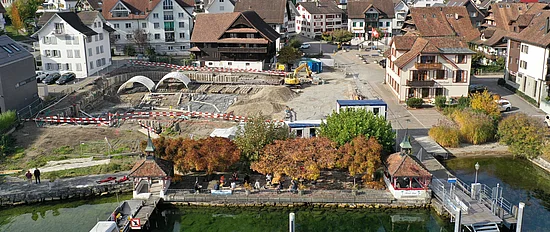
In our project, we want to tackle, with cutting edge methods, four main questions that relate to our basic concepts of settlements, economy, and communities in the late fourth and early third millennium BC in the northern alpine foreland. We endeavour to develop a synergistic framework for future monument preservation techniques, delivering simultaneously data on cultural, economic and ecological aspects related to Neolithic lakeshore settlements. The sedimentary records, in particular the organically preserved cultural deposits of lakeshore settlements, are a hitherto unused enormous genomic archive that we will explore and compare to established bioarchaeological approaches. This unprecedented approach will enable us to address four main research questions:
- Were the Neolithic lakeshore communities in the northern alpine foreland as autarchic and sedentary as traditional models suggest? Or were they highly mobile in the course of a year engaging in different seasonal economic activities in different places? In other words: Was the Lakeside Neolithic a low-level food production economy in the sense of Bruce Smith (2001)?
- Who lived in the houses in the lakeshore settlements and how far can we get in identifying the inhabitants genetically?
- How did the lakeshore settlements interact with and influence their natural environment, both on land and in water, and how were lake ecosystems altered by the human activities?
- How can underwater monument preservation in the middle 21st century reconcile the needs of monument preservation and relevant research?
We will develop minimally invasive methods that allow to combine the completion of the inventory of preserved monuments – as postulated in the Valletta-convention in 1992 (www.coe.int/en/web/culture-and-heritage/valletta-convention) – with the protection of the sites and still produce relevant data for innovative research.
To this aim, we will apply established bioarchaeological (botany, zoology, palynology) and isotope analyses in combination with analysis of ancient environmental DNA (aeDNA) on sedimentary deposits focusing on cultural layers of two Neolithic lakeshore settlements. For this highly specialized interdisciplinary approach, our project combines the expertise of leading international researchers in the fields of wetland archaeology, bioarchaeology and ancient environmental genomics and includes three PhD and one Postdoctoral positions. Switzerland, Germany and Austria have lakeside settlements which form part of the common UNESCO World Heritage. The cooperation of specialists from all three countries guarantees the knowledge transfer in the emerging field of aeDNA-studies and the development of a common toolkit for research and preservation. In this project, we will focus on two Swiss sites with organic preservation. They provide ideal conditions for the outlined approach, clear settlement ground plans, a wealth of samples and a well understood taphonomy. It is the first time that environmental ancient DNA of cultural deposits from lakeside settlements will be investigated. This first systematic parallel study of aeDNA and established bioarchaeology on cultural deposits will be indispensable to understand the new datasets and each method’s strengths, weaknesses and blind spots. This project offers the unique possibility to develop an advanced inter- and transdisciplinary approach that can serve as a standard for the future investigation of lakeside settlements.
Funding









Social Media